Exports and downloads
What you can take out of Projectri, in which formats, who is allowed to, and what a download deliberately leaves behind.
What it is
A download is a copy of the thing it was downloaded from. Projectri writes its own PDFs, Word files, Markdown and CSV on the server, from the same model the screen renders — so an exported board is vector art with selectable text rather than a screenshot, and an exported note has the same headings and lists the editor showed.
How to get there
There is no single exports screen. Each thing that can be exported carries its own control:
| What | Where | Formats | Needs |
|---|---|---|---|
| A note | the note's menu | PDF, Word, Markdown, plain text | note.view and access to the note |
| A document | the document's menu | PDF, Word, Markdown, plain text | document.view and access to the document |
| A whiteboard | the board's menu | board.view | |
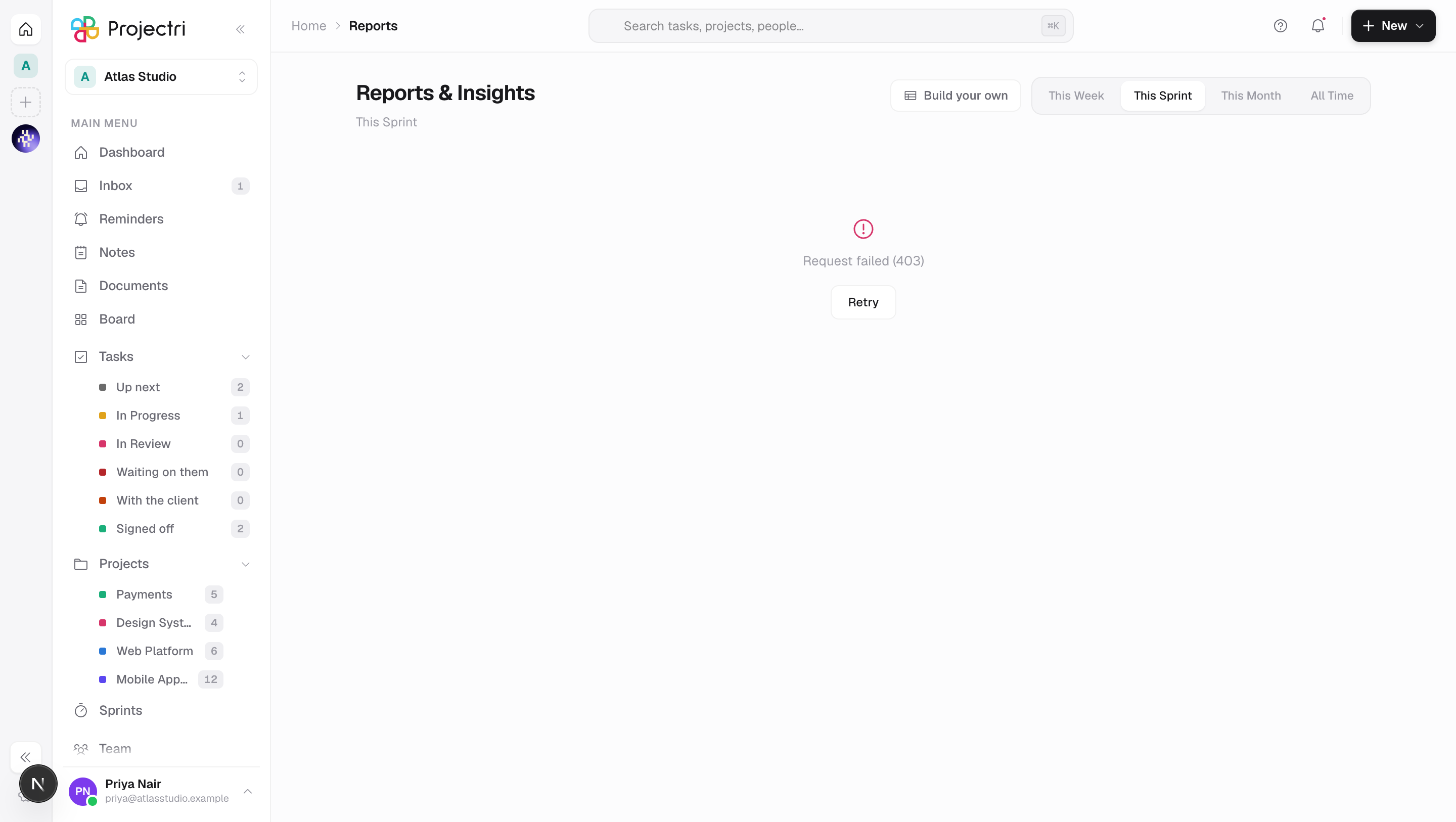
| A saved report | the report | CSV | report.export |
| The audit log | Admin → Audit log | CSV, JSON, NDJSON, CEF | security.audit_export |
| Console lists — invoices, reports, tax summaries, timesheet compliance | the list itself | CSV | the list's own key |
| Everything about one person | Admin → Privacy → Requests | a zip | privacy.request.manage |
Project data carries its own key, project.export.
How to use it
Export a note, a document or a board
- Open it and choose the export format from its menu.
- A board can only be a PDF. The other formats are text-shaped and would throw away everything except the labels.
- A board's PDF can be landscape or portrait.
Export a report
- Open the saved report, choose export.
- A pivot exports as the cross-tab you are looking at, not the flat rows behind it — exporting the flat result and letting a spreadsheet re-pivot loses the axis order, the column cap and the subtotals, and produces a file that disagrees with the screen.
- Truncation is written into the file. A capped result carries a line saying how many rows or columns were shown out of how many, and any column omitted for want of permission is named.
Export the audit log
- Admin → Audit log, filter by date range and action, then export.
- CEF is there for a security team feeding a SIEM by hand; JSON and NDJSON for a pipeline; CSV for a spreadsheet.
- It is capped at 50,000 rows. When the cap bites, the response says so in a header and names the point to resume from — a truncated export must read as truncated rather than as a complete file quietly missing a million rows.
- The export itself writes an audit entry. A bulk read of the record of who did what is itself a thing worth recording.
What it affects
- A PDF is set in the type it was set in on screen. Six families are embedded, subset, for anything whose typeface was the user's choice — a board, a note. Everything whose type is the app's choice draws in the standard reader fonts, which cost the file nothing.
- What survives depends on the format. Bold, italic and strike survive all three rich formats. Underline, colour, highlight, alignment and super/subscript survive PDF and Word; Markdown writes raw HTML for those it has no syntax for. Plain text expresses none of it and does not try.
- **Images are embedded in PDF, referenced in Markdown, and a placeholder in Word and text.**
- Arabic is drawn in Noto Sans Arabic whatever family a run asked for. A typeface is a preference; a script the file cannot draw at all is not something to trade against it.
- An export is a permission-checked read, so it contains what you could see on the screen and nothing more. Cost columns are dropped for anybody without the financial reporting key, rather than the whole export being refused.
On mobile
Exports are web-only. A bulk file exists to be handed to somebody — a regulator, a SIEM, a spreadsheet — and a handset has nowhere to put it and nothing to open it with. Reading the audit log itself is on the phone.
Limits and gotchas
- Nothing end-to-end encrypted is in any export. An encrypted channel or direct message is ciphertext to the server. A personal data export says so in words, lists your device key fingerprints and points at the device-side path, rather than silently omitting it.
- A board label is clipped, not wrapped. The PDF copies the canvas geometry exactly, so a label that fits on screen fits in the file — and one that was already truncated stays truncated.
- Word gets a placeholder where an image was.
- A colour the format cannot express becomes no colour, never black. A writer falling back to black would paint an opaque band over the very text a highlight was meant to emphasise.
Related
- Report builder — building the report a CSV comes out of.
- Audit log — the log itself, and streaming it continuously.
- Data and privacy — the complete export about one person.
- The API, MCP and apps — reading data out continuously rather than as a file.