Languages, dates and the working week
The eight locales Projectri formats in, the two it speaks, right-to-left layout, and the one setting that decides which days of the week count as work.

What it is
Two separate capabilities, and keeping them apart is what makes this useful.
Formatting — dates, numbers, currency and plural rules — works in all eight locales today: English, Arabic, French, Spanish, German, Portuguese, Hindi and Japanese. Messages — the words on the buttons — exist in English and Arabic. A French workspace gets French dates, French number grouping and euro formatting immediately, and English text until that catalogue lands.
Separately, and more consequentially, your workspace's country decides its working week, and the working week is the denominator of every capacity and utilisation figure in the product.
How to get there
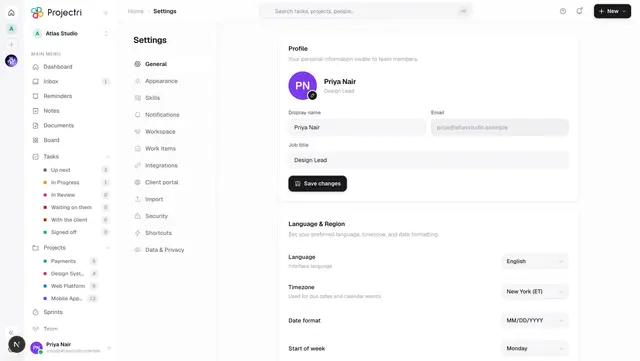
Your own language, date format and week start are at Settings. The workspace's defaults are at Admin → Settings, and its country is on Admin → Company. Nothing here needs a permission for your own settings; the workspace ones are an admin act.
How to use it
Change your own language
- Settings → your language.
- It takes effect immediately on the web. On the phone, switching to or from Arabic needs an app restart on Android for the layout to flip fully — the flag is set and the next launch picks it up, rather than pretending the current one has re-laid out.
Understand which language you get
The chain is: **your setting → your workspace's default → your browser's Accept-Language → English**. It is not in the URL, and that is deliberate:
- A shared link renders in the reader's language, not the sender's. Pasting a task URL into a channel does not change the language for everyone who opens it.
- The client portal is per contact, not per firm. A German agency serving a client in Riyadh sends that client an Arabic portal while its own staff stay in German.
- On the phone the chain is one link shorter: **your setting → the device's language → English**. A phone has one owner, and a workspace default overriding the handset's own setting would be the app disagreeing with every other app on it.
Set the country, and get the working week
- Admin → Company, set the country.
- That one choice provisions the timezone, the currency, the date format, the language, the week start, the working days, the default holiday calendar and the public holidays for that country.
| Working week | Countries |
|---|---|
| Sunday–Thursday | UAE, Bahrain, Egypt, Israel, Iraq, Jordan, Kuwait, Libya, Oman, Palestine, Qatar, Saudi Arabia, Syria, Yemen |
| Saturday–Wednesday | Afghanistan |
| Saturday–Thursday | Iran, Nepal |
| Monday–Friday | everywhere else |
A separate, smaller list decides only which column a calendar month starts in — the United States, Canada, Japan, Brazil, the Philippines, South Africa and others begin the grid on Sunday while still working Monday to Friday.
What it affects
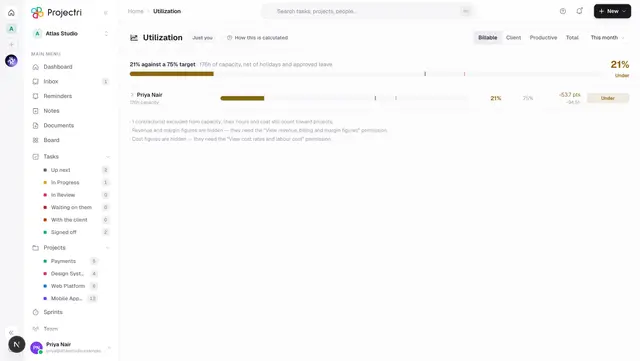
- Capacity and utilisation. Working days between two dates is the denominator of every availability, capacity and utilisation figure. A Gulf workspace left on Monday–Friday has every person's available hours wrong by a day a week, and it lands directly on the utilisation number the board sees.
- Due dates and delays. An automation's "wait two working days" reads the same calendar.
- Notifications go out in the recipient's language, not the language of whoever clicked. A thread with an Arabic client and a French owner produces two emails rather than one.
- Right-to-left. Arabic mirrors the whole interface — web, portal and phone. PDF exports draw Arabic in an embedded Arabic face whatever typeface a run asked for, and shape and reorder it correctly.
- Money is formatted per currency, with the right number of minor units for each of 149 currencies. Amounts on the wire are always integer minor units with the currency beside them.
- Public holidays seed the default calendar only when the country was actually recognised. Generating the American set for a workspace that never said "US" would put eleven wrong days into a real capacity denominator, which is worse than an empty calendar — an empty one is visibly empty.
On mobile
The app carries a verified copy of the same message catalogues and renders the same plural and select rules; every message in every catalogue is rendered by both engines at test time and must match character for character. Arabic plurals have six categories and the phone implements all of them rather than calling into the platform, because the JavaScript engine React Native uses ships only part of the standard library that would answer them.
Limits and gotchas
- Six of the eight locales have no message catalogue yet. French, Spanish, German, Portuguese, Hindi and Japanese resolve, format and fall back to English text. That is a real improvement — dates, numbers and currency are right — and it is not a translated product.
- A missing translation renders English, never a raw key. Catalogues are merged before lookup, so a half-translated language still formats plurals and interpolations correctly.
- The reporting currency is a one-way door. Once any money has been recorded in a workspace, its reporting currency cannot be changed: every stored base amount is defined as being in that currency, so switching would silently reinterpret the entire history rather than converting it. A workspace that picked wrong in its first ten minutes has nothing to lose; one that picked it two years ago has everything.
- The residency pin cannot be moved either. Changing the country later updates the locale settings and does not move an existing residency pin.
- Nia and the voice assistant are English-only.
- The platform console is not translated, deliberately. It is staff-facing.
- A retired language falls through rather than stopping the chain. An account holding a language we no longer ship resolves to the workspace's, not to English.
Related
- Your settings — your own language, date format and week start.
- Workspace settings — the workspace defaults.
- Company — the country, and everything it provisions.
- Utilisation — the figure the working week is the denominator of.